
On This page
    Concerned daughter holds mothers hand concerned to symbolize nursing home abuse or neglect

    When a loved one in a long-term care facility suffers a broken bone, the impact can be profound. At Joye Law Firm Injury Lawyers, we understand how devastating these injuries are and how negligent practices can lead to nursing home abuse.

    Since 1968, Joye Law Firm Injury Lawyers has been committed to standing up for those injured by nursing home negligence. We work closely with a team of nurses and a network of attorneys with extensive experience in these cases. Together, we’ve helped people across the state, including $497,500 for a client who broke a hip in a fall, $875,000 for a resident who fractured their neck and pelvis in a wheelchair accident, and $250,000 for a client who suffered multiple falls resulting in hip and facial injuries. We’re here to hold negligent nursing home facilities accountable and help families find the answers and support they need.

    This guide walks you through how and why broken bones occur in nursing homes, how common they are, which fractures are most frequent, and when such injuries may signal neglect or abuse. We also explain the consequences of these injuries, what you should do if your loved one suffers bone fractures, how nursing homes can prevent them, and when it might be time to consult a lawyer.

    What Causes Broken Bones in Nursing Homes?

    Broken bones among nursing home residents often stem from a convergence of factors that uniquely affect older adults in care settings: the risk of falling, frail bones due to aging or osteoporosis, unsafe environments, and under-trained or insufficient staff.

    1. Falls

    Falls are the leading trigger for broken bones in nursing homes. A resident might slip, trip, or attempt to transfer themselves without proper assistance. According to the Centers for Disease Control and Prevention (CDC), falls are the most common cause of hip fractures in older adults. Within care communities, one study noted that about 175,000 residents had fallen in the past 90 days (about 22% of residents).

    In nursing homes, medication side effects, cluttered areas, wet floors, poor lighting, unsecured wheelchairs or walkers, and trip hazards all increase the chance of elderly nursing home residents falls.

    2. Poor Transfer Techniques & Mobility Assists

    Many nursing home residents require assistance getting in and out of bed, moving from wheelchair to chair, or walking with a walker. When nursing home staff members use improper transfer methods, stress fractures, wrist fractures, or hip fractures can occur. Accidents can also happen when faulty or poorly maintained equipment, such as lifts, wheelchairs, or walkers, breaks or malfunctions during use. This includes:

    • Lifting without equipment
    • Failing to use gait belts
    • Leaving a resident unattended during transfers
    • Improper handling or forced movement
    • Improper use of equipment such as Hoyer Lifts

    3. Unsafe Environments & Poor Supervision

    Unsafe nursing home conditions raise the risk that fragile residents will fall and suffer fractured bone injuries. Moreover, staff under-training or understaffing results in fewer caregivers to monitor residents, fewer opportunities to assist with safe transfers, and less time to perform fall risk assessments. Thus, there is an increased risk of nursing home fractures.

    4. Fragile Bones in the Elderly (including Osteoporosis)

    As people age, bones typically become less dense and more fragile. Conditions like osteoporosis in seniors significantly raise the risk that even a minor fall or misstep will result in a fracture. Elderly residents may also have limited mobility, balance issues, muscle weakness, medications that cause dizziness, and chronic diseases.

    5. Combined Effects

    In many nursing homes, broken bones arise from a combination of the above: a resident with fragile bones (osteoporosis) tries to get up unassisted, the floor is wet or poorly lit, staff fail to assist properly, and the resident falls and suffers a hip fracture. In such cases, it is not simply an accident but may reflect nursing home negligence or poor adherence to care standards.

    How Common Are Broken Bones in Nursing Homes?

    Unexplained broken bones among nursing home residents are unfortunately common, and the statistics help illustrate the scale and seriousness of the problem.

    • According to the CDC, each year, there are nearly 319,000 hospitalizations for hip fractures among older adults (ages 65+).
    • Of those hip fracture hospitalizations, about 88% of the visits and 83% of the deaths are caused by falls.
    • For long-stay nursing home residents in the U.S., a study found the incidence of hip fracture was about 3 per 100 person/year. With about 1 million long-stay residents, that translates to about 23,000 hip fractures per year in nursing homes.
    • Further data suggest that in nursing homes, about 20% of falls lead to serious injuries like fractures.

    Given this data, it is clear that broken bones are a real and significant risk in long-term care facilities. Complicating matters, the actual number may be under-reported. Fractures might go unrecorded, and not all falls are properly investigated.

    Which residents are especially at risk? Those who are older (especially 85+), have limited mobility or muscle weakness, have cognitive impairment or dementia (which may reduce recognition of hazards or inability to call for help), are under-supervised, or reside in facilities with high staff turnover or under-trained staff.

    Which Types of Fractures Are Most Common in Nursing Homes?

    When nursing home residents suffer from broken bones, certain fracture types occur more frequently. Each carries its own severity, recovery concerns, and mobility implications.

    1. Hip FracturesTypes of Fractures most common in nursing home falls
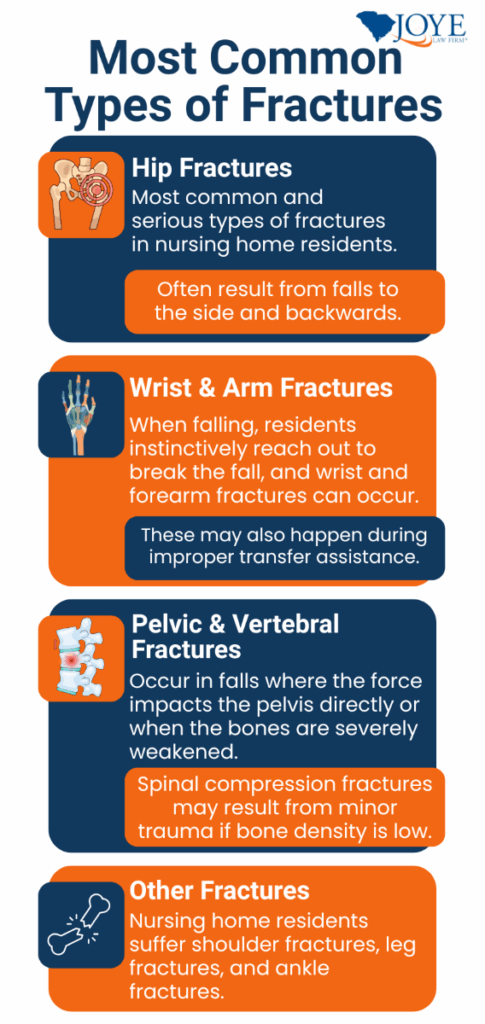
    Hip fractures are among the most common and serious types of fractures in older adults and nursing home residents. They often result from a fall to the side or backward and can require surgical intervention.

    2. Wrist & Arm Fractures

    When a resident falls and instinctively reaches out to break the fall, wrist fractures and forearm fractures can occur. These are common “broken bone” injuries in seniors and may also happen during improper transfer assistance.

    3. Pelvic and Vertebral (Spinal Compression) Fractures

    Pelvic fractures may occur in falls where the force impacts the pelvis directly or when the bones are severely weakened. Spinal compression fractures (vertebrae) may result from minor trauma if the bone density is low or a resident is lifted improperly.

    4. Other Fractures: Shoulder, Leg, Ankle

    Nursing home residents are also at risk for shoulder fractures, leg fractures, and ankle fractures. While perhaps less life-threatening than hip fractures, they still significantly impair mobility, prolong rehabilitation, and increase the risk of further injury.

    Are Broken Bones a Sign of Nursing Home Neglect or Abuse?

    While not every fracture in a nursing home is the result of neglect or abuse, there are circumstances in which unexplained broken bones may signal serious problems, such as neglect in long-term care or physical abuse.

    Red Flags That Suggest Neglect or Abuse

    Here are some warning signs to watch for:

    • A fracture occurs under “unclear” circumstances (for example, the nursing home’s explanation is vague or inconsistent).
    • Multiple fractures or unexplained injuries in a short period of time.
    • Old healing fractures were found on the X-ray that were not documented or explained.
    • A fracture in a resident who is essentially immobile or bed-bound (making a fall less believable).
    • Lack of incident report, delayed treatment, or no documentation of the fall and subsequent care.
    • Repeated falls without adequate supervision or corrective action.
    • A resident indicates that staff used excessive force or rough handling.
    • The facility fails to assess fall risk/have a proper care plan or ignores known hazards.

    Neglect and Physical Abuse in Nursing Homes

    When a nursing home’s staff fails to monitor residents, fails to assist transfers properly, or fails to provide a safe environment (e.g., not repairing hazards, not clearing clutter, not responding promptly to call lights), those lapses may amount to nursing home negligence.

    In some cases, fractures may be caused by physical abuse (e.g., a resident being roughly transferred, mishandled, or assaulted by staff or other residents).

    What Are the Consequences of a Broken Bone for an Older Adult?

    For nursing home residents, a fractured bone is not just a broken bone. It can trigger a downward spiral of medical, functional, emotional, and financial consequences.

    Medical & Functional Impact

    • Loss of mobility: A hip fracture or other severe fracture often means limited or no walking, a higher risk of being confined to bed or a wheelchair, and increased dependence on care.
    • Complications: Older adults with fractures are at higher risk of developing infections, pressure ulcers, pneumonia, blood clots, and slower healing.
    • Longer recovery time: Recovery is slower in older adults, especially those with other comorbidities such as dementia, diabetes, heart disease, or osteoporosis.
    • Increased mortality: One shocking report found that for nursing home residents, one in three dies within 180 days of a hip fracture.
    • Chronic pain and disability: Some residents never regain their former function, leaving them more vulnerable to additional falls or other injury.

    Psychological & Quality of Life Impact

    • Fear of falling again: Once a resident fractures a bone, they may become fearful, reduce activity, and avoid movement. Ironically, it increases the risk of further falls due to muscle atrophy and reduced balance.
    • Loss of independence: Many residents may go from independent or semi-independent mobility to full dependence on staff.
    • Depression and social isolation: Loss of mobility and independence can lead to depression, withdrawal, and reduced interaction with other residents or family.
    • Higher care needs and cost: A broken bone can escalate the level of care required, including physical therapy, longer rehabilitation, assistive devices, and increased caregiving.
    • Reduced quality of life: What may have once been a comfortable living situation becomes one of increased restriction, pain, and decline.

    Impact on Family Members & Facility

    For family members, watching a loved one suffer a fracture can bring shock, guilt, and fear. It may signal that the nursing home facility failed in its duty. For the facility, a broken bone in a resident can lead to liability, regulatory scrutiny, higher care costs, and reputational damage.

    When Should You Contact a Lawyer About a Nursing Home Injury?

    If your loved one in a nursing home has suffered a broken bone, especially under suspicious or unexplained circumstances, it may be time to speak with a personal injury lawyer at Joye Law Firm Injury Lawyers. Here’s how we can help if you suspect nursing home abuse or neglect:

    • Provide a free, confidential consultation to explain your legal rights and options.
    • Review the what happened, gather medical records, nursing home logs, incident reports, and documentation of care practices.
    • Determine whether the nursing home breached its duty of care and whether that breach caused the fracture or worsened the resident’s injury.
    • Evaluate potential compensation for medical bills, physical therapy, rehabilitation, pain and suffering, loss of mobility, and, in catastrophic cases, wrongful death.
    • Advocate for your loved one’s rights, hold the facility accountable, and help you demand answers and changes in proper care going forward.

    FAQs about Broken Bones in Nursing Homes

    Nursing Home Abuse Broken Bones

    Can medication side effects increase the risk of fractures in nursing home residents?

    Yes. Certain medications commonly prescribed to older adults can cause dizziness, drowsiness, or low blood pressure. This includes sedatives, antidepressants, and blood pressure drugs. Nursing home staff should regularly review each resident’s medication list with medical professionals to minimize these risks and monitor for side effects that affect balance or alertness.

    What should families ask after a nursing home reports a fracture?

    Families should ask for specific details about when, where, and how the incident occurred. Request to see the incident report, the resident’s care plan, and any witness statements. It’s also important to confirm whether the nursing home updated safety measures afterward. If explanations are inconsistent or vague, that could indicate potential negligence.

    How long does it take for an elderly resident to recover from a broken bone?

    Recovery depends on the resident’s overall health, type of fracture, and the quality of rehabilitation care. While a minor wrist fracture might heal in six to eight weeks, a hip fracture can take months and often results in long-term mobility limitations. Access to proper physical therapy and pain management greatly affects recovery outcomes.

    Are nursing homes legally required to prevent falls and fractures?

    Yes. Nursing homes have a legal and ethical duty to maintain a safe environment, conduct regular fall risk assessments, and provide adequate staffing and training. Federal regulations under the Centers for Medicare & Medicaid Services (CMS) require facilities to ensure residents remain as free as possible from accidents and injuries through preventive care and supervision.

    What evidence can help prove negligence after a fracture in a nursing home?

    Compelling evidence includes medical records, photographs of injuries or unsafe areas, staffing schedules, surveillance footage, and witness statements from residents or employees. Documentation showing prior complaints, repeated falls, or ignored hazards can also demonstrate a pattern of neglect. An experienced nursing home abuse lawyer can help collect and preserve this evidence effectively.

    Call a Nursing Home Abuse Lawyer After a Bone Fracture in a Nursing Home Facility

    Broken bones in nursing homes are wake-up calls about the quality of care and oversight within a facility. When an elderly resident fractures a bone, families often feel confused and concerned. The question isn’t only how the injury happened, but also whether it could have been prevented with proper supervision, safe conditions, or attentive staff.

    At Joye Law Firm Injury Lawyers, we believe that accountability drives change. Our legal team has helped families uncover the truth behind nursing home injuries and obtain fair compensation to support their loved ones’ recovery. If your loved one has suffered a fracture, you have the right to demand transparency, proper care, and fair compensation. Let us help you uncover the truth, protect your family’s interests, and guide you through the process with compassion and professionalism.

    At Joye Law Firm Injury Lawyers, we’re legal advocates who help restore safety, trust, and peace of mind for families who’ve endured preventable harm. Call us at (843) 554-3100 for a free consultation. We’ll listen, investigate, and fight to ensure your family receives the justice and protection every senior deserves.

    Contact us
    Mark Joye and Ken Harrell discussing a case